
Your code is clean. Your architecture is scalable.
And you just got ghosted by a German startup. Again.
In the 2026 remote market, your technical skills are a commodity. You can find a “good” developer anywhere from Warsaw to Vietnam. Global firms aren’t hiring you for your ability to write Python; they are hiring you for your ability to integrate into their system without creating friction.
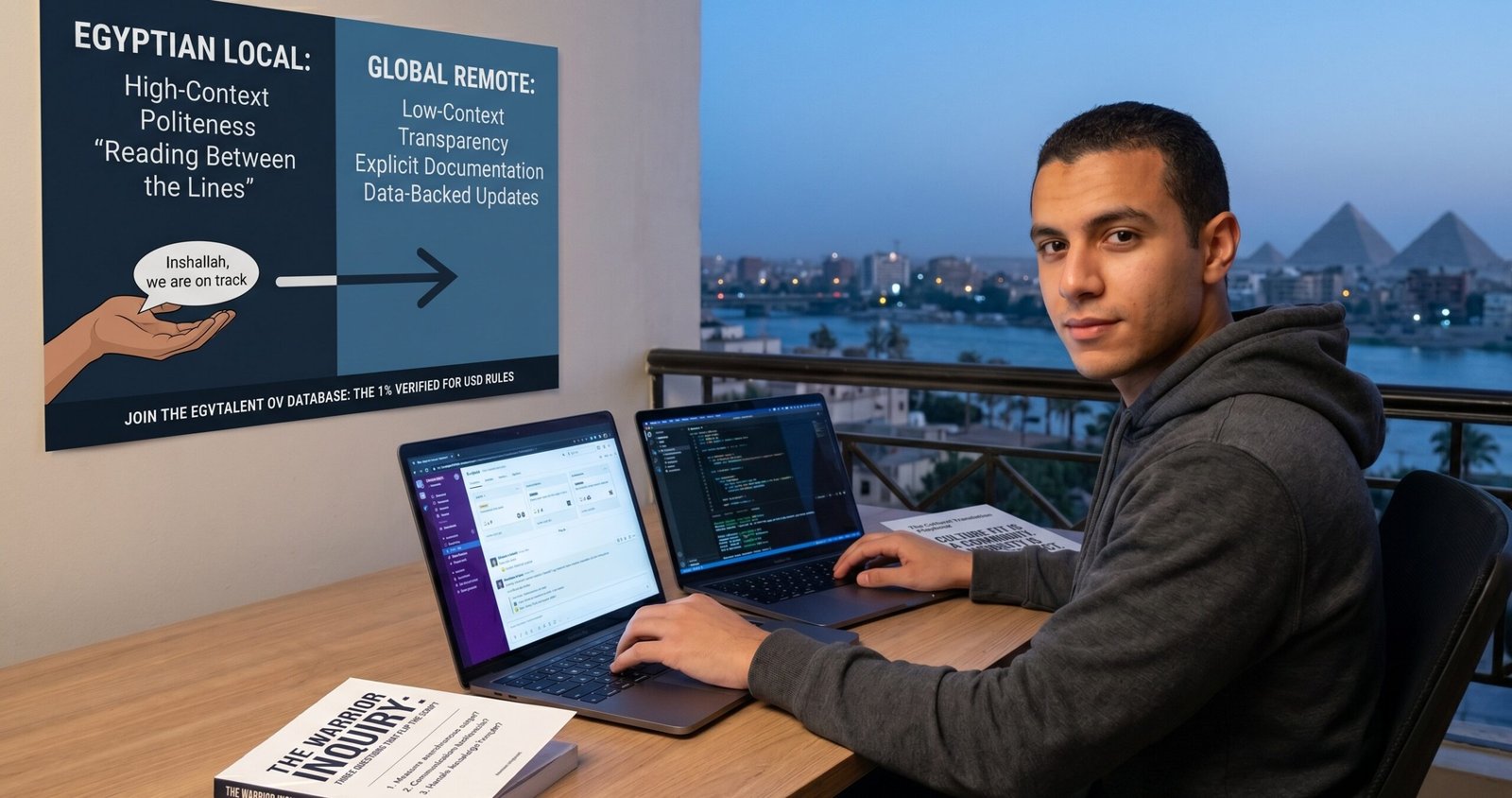
The #1 reason Egyptian professionals fail the “Culture Fit” round isn’t a lack of talent. It’s the Cultural Translation Gap. You are trying to play a global, low-context game using a local, high-context playbook.
By the end of this post, you’ll know the exact three questions that flip this script, but first, you need to understand why your “politeness” is killing your chances.
1. The “High-Context” Trap: Why Your Politeness is a Red Flag
Egyptian culture is fundamentally “High-Context.” We rely on relationships, tone, and “reading between the lines.” We assume the other person understands the “vibe” and the history.
Global Remote Culture is “Low-Context.” In a distributed team, if it isn’t documented, it didn’t happen. Most Egyptian professionals fail because they communicate “Egyptian-style”: they wait for a manager to ask for an update, or they give vague, reassuring answers like “Inshallah, we are on track.”
To a PM in London, “Inshallah” isn’t a cultural expression; it’s a lack of data. It sounds like you’re hiding a blocker. To bypass this, you must stop being a “polite employee” and start being a Documentarian. If you aren’t providing explicit, data-backed updates before being asked, you are a liability.
Global firms don’t want “politeness”; they want transparency.
2. Visibility is the Product: Overcoming the Trust Deficit
Because you are working from Egypt, you start with a “Trust Deficit.”
The world expects you to have power cuts, internet outages, and communication lags. The only way to kill this bias is to make your work impossible to miss. In a remote setting, if you aren’t visible, you don’t exist.
How to build trust without a shared office:
-
The Loom Strategy: Instead of a 30-minute meeting that kills the team’s momentum, send a 2-minute Loom video. “Here is the update, here is the blocker, here is the solution.”
-
The 5-Minute Rule: Trust isn’t built at virtual happy hours. It’s built by being the person who updates the Jira ticket at 3:55 PM for a 4:00 PM deadline.
-
Social Capital through Reliability: Every time you communicate clearly without being prompted, you buy Social Capital. Every time you stay silent for 24 hours, you burn it.
You aren’t just selling your output; you are selling the peace of mind that the work is moving forward while the team is asleep in another timezone.
3. Honest Friction vs. The “Yes” Man
In the local market, “Yes” is the safe answer. You don’t want to disappoint the boss, so you agree to an impossible deadline and then scramble (or fail) in private.
In a high-performing remote team, “Yes” to an impossible deadline is a lie. Global firms value Honest Friction. They need you to tell them “No.” They need to hear: “I cannot finish this by Friday because of X, but I can deliver the core module by Monday.”
When you agree to everything to be “polite” and then miss the mark, you prove you aren’t a Senior. A true Senior protects the project by being honest about limitations. If you can’t speak the truth to power, you’ll never earn USD.
4. The “Warrior” Inquiry: Closing the Interview
The ultimate test of this trust isn’t in your Slack updates, it’s in the final ten minutes of the interview.
When they ask, “Do you have any questions for us?” the local applicant says, “No, everything is clear.” They want to look easy to manage. The Remote Warrior uses this moment to prove they are a strategist. If you don’t ask high-level operational questions, they assume you’re a junior who needs hand-holding.
Ask these three questions to flip the script:
-
“How do you measure individual output vs. presence in an asynchronous environment?”
-
“What is the team’s biggest bottleneck in communication across time zones right now?”
-
“How does the team handle knowledge transfer when a lead is offline?”
These questions tell the recruiter you aren’t looking for a “job”, you’re looking to optimize their system.
The Case for Translation
This isn’t theory. Take the backend dev I worked with, who recently landed a €2,500/month contract in Amsterdam. He didn’t win on code; he won by surfacing a critical deployment bottleneck during the technical interview that the founder hadn’t even identified yet. He was a Cultural Translator from minute one.
Recruiters are currently scouring our internal systems looking for talent that doesn’t need “translation.” They are looking for the person who understands the frequency of global remote work.
The local market will always reward your silence. The global market only rewards your signals.
Join the Egytalent CV Database: The 1% of Egyptian Talent Verified for USD Roles