You did everything right.
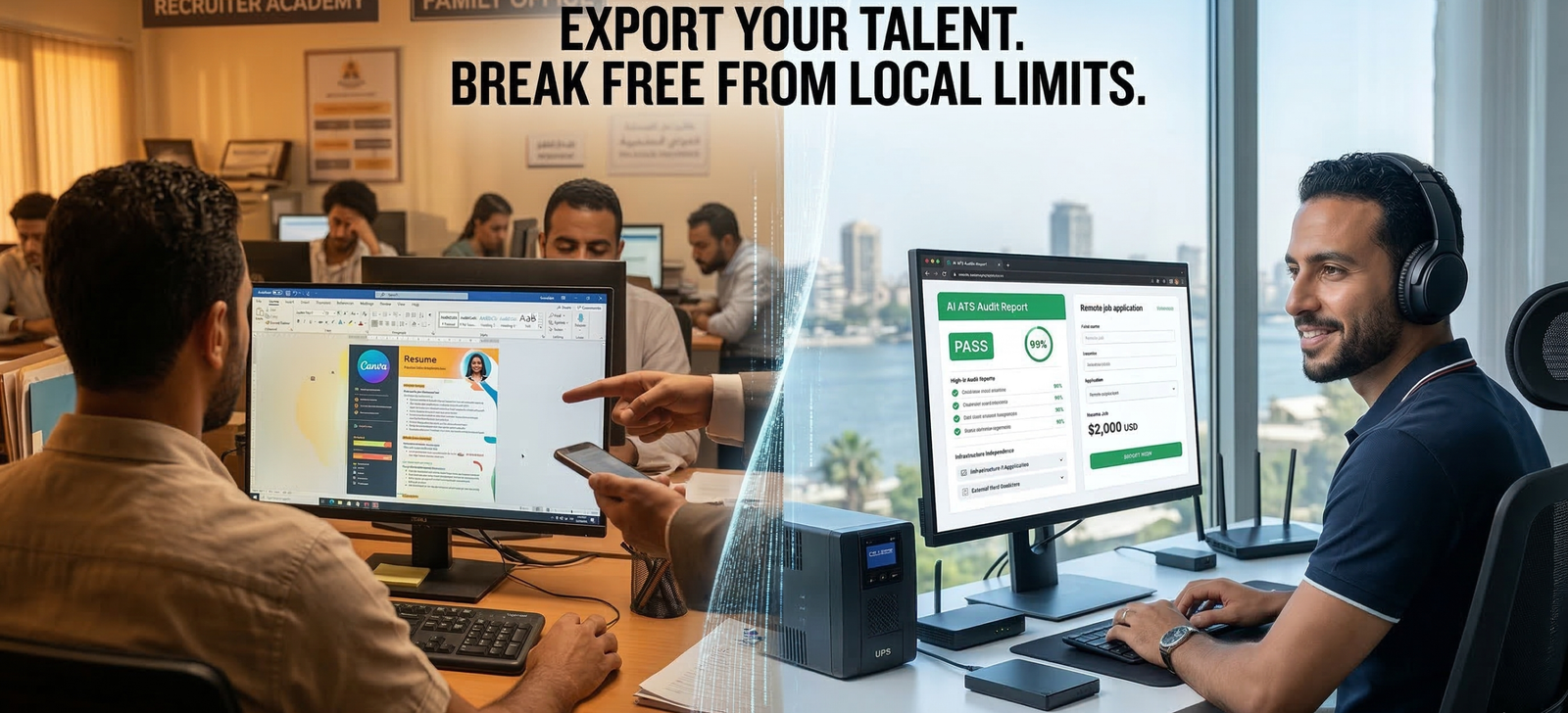
You fixed your CV. You passed the ATS. You sent your application on Day One.
And then it happened. The calendar invite landed in your inbox. A recruiter from a company in Amsterdam, Toronto, or Austin wants to talk to you.
This is the moment most Egyptian professionals have been waiting for. And it’s exactly where most of them lose.
Not because they aren’t qualified. Not because their English isn’t good enough. But because the global interview is a different game, with different rules, and nobody told you what they are.
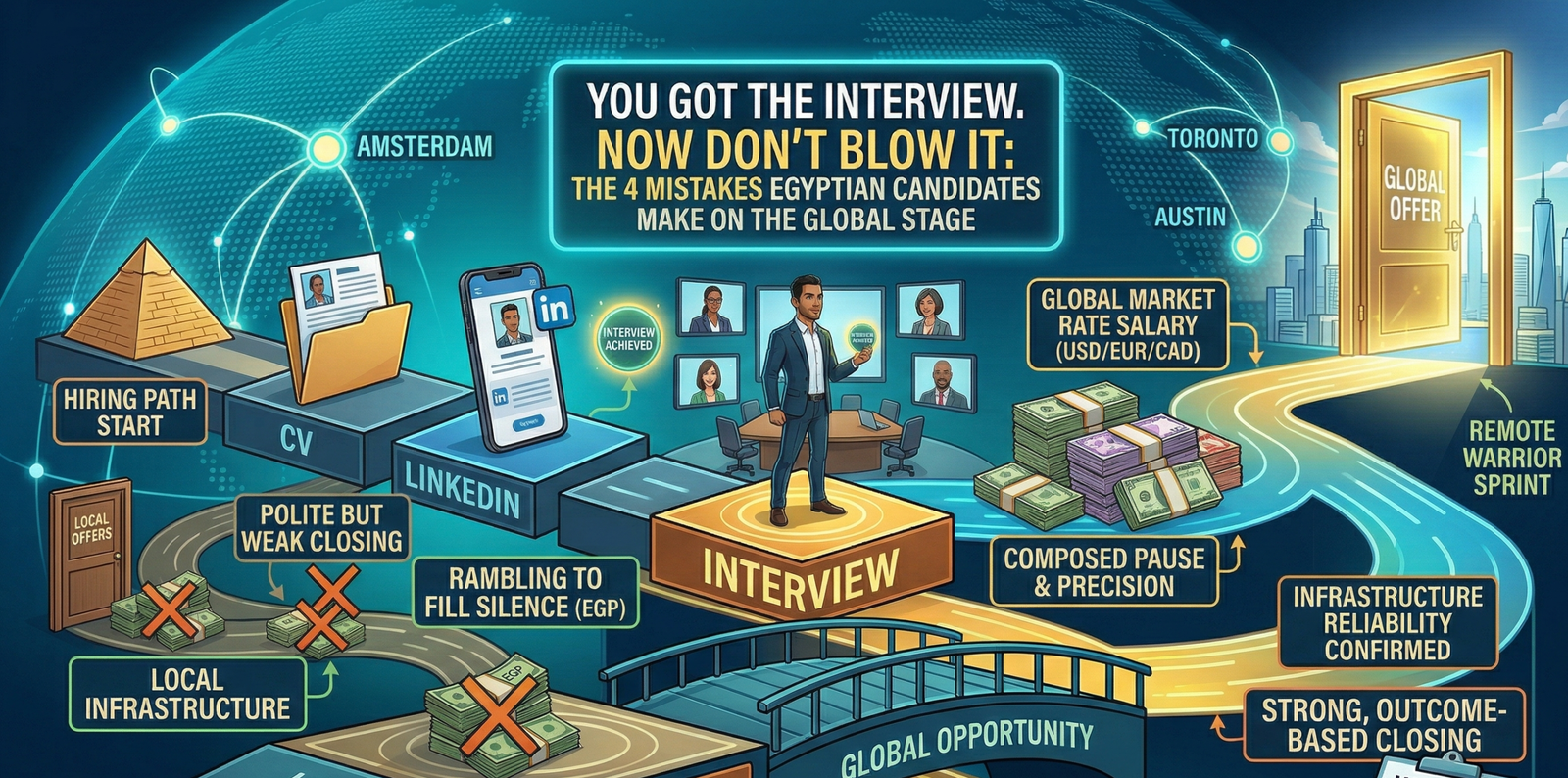
Here are the 4 mistakes that are killing your offer at the finish line.
1. You Answer the Salary Question in EGP (Even When You Answer in USD)
The recruiter asks: “What are your salary expectations?”
You panic. You do the mental math. You think about your current local salary, multiply it by the exchange rate, add a “buffer,” and say: “I’m looking for around $1,200 to $1,500 USD per month.”
You just failed. Not because the number is wrong for your life. Because it tells the recruiter exactly where you anchored your thinking.
A candidate in Eastern Europe with the same skills just said $3,500. The recruiter now sees two options: a “cheap local hire” and a “professional remote worker.” Guess which one gets the offer?
The Fix: Research the role’s market rate on Glassdoor, Levels. fyi, or LinkedIn Salary. Not in Egypt. In the country of the hiring company. Anchor your number there, then justify it with your output, not your location. Say: “Based on the scope of this role and the market rate for this function, I’m targeting $X. My track record of [specific result] tells me I can deliver that value.”
Your salary is not a function of where you sleep. It is a function of what you produce.
2. You Treat Silence Like Failure
In a local Egyptian interview, silence is awkward. You fill it. You over-explain. You keep talking until you feel safe.
In a global remote interview, especially with async-first companies, silence is data. The interviewer is often typing notes, processing your answer, or simply waiting to see if you self-correct under pressure.
When you fill that silence with rambling, you signal one thing: you need to be managed. And a remote company doesn’t want to manage you. They want to deploy you.
The Fix: Answer the question. Stop. Let it land. Count to three in your head if you have to. If there’s silence, hold it. The first person to speak out of discomfort loses the frame. A composed pause signals confidence. A nervous monologue signals someone who will flood the Slack channel with anxiety at 11 PM.
3. You Never Kill the “Egypt Risk” Objection
This is the one that costs the most, and it almost never gets said out loud.
The recruiter likes you. The hiring manager is interested. But somewhere in the back of their mind is a question they won’t ask directly: “What happens when the power goes out? What happens during Ramadan? What happens if there’s political instability?”
They don’t ask it. They just don’t send the offer.
The Fix: You kill the objection before it even gets started. In the first 15 minutes of the interview, you bring it up yourself:
“I want to briefly address remote reliability, since I know it’s a real concern when hiring from Egypt. I run a dual-ISP setup with a UPS battery backup, giving me a 99.9% uptime track record. I also operate fully async and have never missed a deadline due to infrastructure.”
That one paragraph does three things. It shows self-awareness. It demonstrates professionalism. And it removes the “Egypt Risk” from the recruiter’s mental checklist before they even build it. You are not on defense. You are on offense.
4. You Close the Interview Without Closing the Recruiter
Most Egyptian candidates end the interview the same way. The recruiter asks, “Do you have any questions for us?” and you ask a polite question about company culture or team size. Then you say thank you, log off, and wait.
That waiting is where offers go to die.
The global standard is not to wait. It is to advance.
A candidate who closes the interview with intention sounds like this: “Based on everything we’ve discussed today, I’m genuinely excited about this role and I believe I can deliver [specific result] within the first 90 days. What are the next steps in your process, and is there anything you need from me to move forward quickly?”
That single question does more work than your entire cover letter. It signals urgency without desperation. It shows you think in outcomes. And it puts the next move on the recruiter’s calendar rather than leaving it in limbo.
The Fix: Prepare your closing statement before the interview, not after. Know what specific value you will deliver in the first 30, 60, and 90 days. When the interview ends, don’t just say goodbye. Close the loop.
The recruiter remembers the last 60 seconds of every interview more than anything else. Make those 60 seconds count.
The Pattern You Need to See
Look at all four mistakes. They share a root cause.
You are walking into a global interview still thinking like a local hire. Someone who negotiates from weakness, fills silence out of fear, never addresses the elephant in the room, and waits to be judged instead of taking control of the narrative.
The global remote market doesn’t want someone who is “grateful for the opportunity.” It wants an Autonomous Operator. Someone who knows their value, communicates with precision, and makes the recruiter feel like the risk of not hiring them is greater than the risk of hiring from Egypt.
That is a mindset shift. And it doesn’t happen by accident.
The Remote Warrior Sprint
If you’ve made it this far and you recognize yourself in any of these four mistakes, the Remote Warrior Sprint was built for exactly this moment.
It covers not just your CV and your application strategy. It covers the full interview battlefield. The salary anchoring scripts. The async communication signals. The infrastructure objection framework. Everything you need to walk into that Zoom call as the candidate they were hoping to find.
Secure Your Spot on the Waiting List
Getting the interview was the hard part. Don’t hand the win back at the door.